# Why BLS Training Is Essential for Emergencies
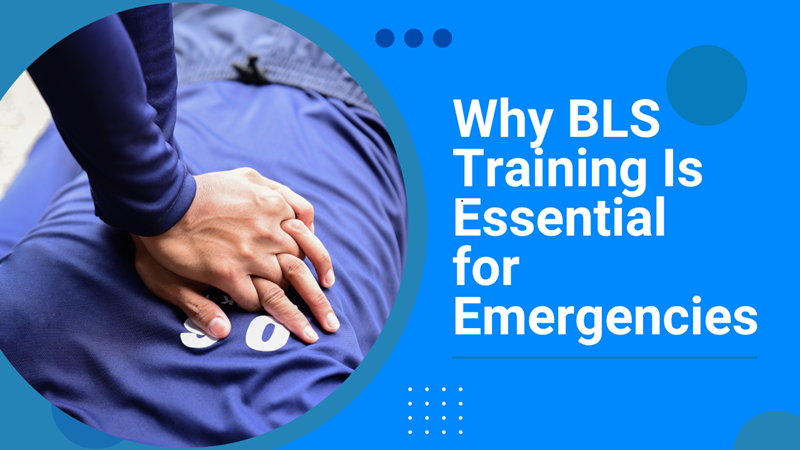
When a medical emergency strikes, time is the ultimate deciding factor between life and death. Whether it is a sudden cardiac arrest at a family gathering, a choking incident at a restaurant, or a severe collapse in the workplace, the first few minutes are critical. This is exactly why BLS training is essential. Basic Life Support (BLS) equips everyday people and healthcare professionals with the foundational skills needed to keep oxygen flowing to the brain and vital organs when a person’s heart stops beating.
Unfortunately, many people freeze during a crisis simply because they do not know what to do. By understanding the importance of BLS and taking advantage of modern, flexible certification methods, you can transform from a helpless bystander into a confident lifesaver.
## The Golden Minutes: Why Immediate Response Matters
To understand why BLS training is essential, you have to look at human physiology. When the heart suddenly stops pumping—a condition known as sudden cardiac arrest—the brain is immediately deprived of oxygen. Brain cells begin to die within four to six minutes. Without immediate intervention, irreversible brain damage and death occur within ten minutes.
### BLS Training Is Essential for Everyone, Not Just Doctors
There is a common misconception that Basic Life Support is only for doctors, nurses, and paramedics. While it is certainly mandatory for healthcare providers, the reality is that the vast majority of out-of-hospital cardiac arrests happen in homes and public spaces. The person standing next to the victim is usually a family member, a coworker, or a random bystander.
This is a primary reason why [**BLS training**](https://cprcart.com/classes/bls/) is essential for laypeople. You do not need a medical degree to perform effective chest compressions or use an AED. These devices are designed to talk you through the process with simple, step-by-step voice prompts. BLS training demystifies these life-saving techniques, proving that anyone with the right knowledge can sustain a life until advanced help arrives.
### Overcoming the Panic Response Through Muscle Memory
In a high-stress emergency, the human body triggers a "fight, flight, or freeze" response. Adrenaline spikes, and logical thinking often shuts down. People who have only read about CPR or watched videos online often freeze when faced with a real, unresponsive person.
### What Does a BLS Course Actually Cover?
A comprehensive BLS course goes far beyond just learning how to push on someone's chest. A solid training program covers the complete chain of survival, including:
- High-Quality CPR: Understanding the correct hand placement, depth (at least 2 inches for adults), and rate (100 to 120 compressions per minute), while allowing for full chest recoil.
- AED Operation: Learning how to turn on the device, apply the pads correctly, and safely deliver a life-saving shock.
- Rescue Breaths: Understanding when and how to provide ventilations, utilizing barrier devices to maintain safety and hygiene.
- Choking Relief: Mastering the Heimlich maneuver (abdominal thrusts) for conscious and unconscious victims of all ages.
- Team Dynamics: For healthcare providers, learning how to communicate and rotate roles efficiently during a resuscitation effort.
### A Modern Approach: The AHA HeartCode® Module
In the past, getting certified meant sitting in a classroom for an entire weekend, listening to lectures, and watching slideshows. Today, the American Heart Association (AHA) has revolutionized the learning experience to fit into busy modern schedules.
We utilize the AHA HeartCode® module, a cutting-edge blended learning approach that makes getting certified incredibly efficient. The HeartCode system recognizes that the cognitive part of learning—the rules, the science, and the step-by-step logic—is best absorbed at your own pace.
With this model, you complete the online learning portion from anywhere. You can log in from your living room, pause the module if you need to take a break, and fully absorb the material without the distraction of a crowded classroom. The online portion uses interactive scenarios and eSimulation technology to test your critical thinking, ensuring you truly understand the "why" behind every life-saving action.
### The Quick 30-Minute Skill Session
While the theoretical knowledge is crucial, saving a life requires physical skill. That is why the AHA HeartCode® module is paired with a quick 30-minute skill session. Once you pass the online portion, you schedule this brief, focused hands-on evaluation.
During this 30-minute skill session, you will demonstrate the techniques you learned online. You will perform chest compressions, show your proficiency with ventilations, and execute an AED simulation on training manikins. This brief session is highly focused—it is not a re-lecture. It is simply an opportunity to prove your physical competency and lock in that vital muscle memory.
### The Confidence to Make a Difference
At the end of the day, the true value of BLS training is confidence. Imagine the difference between standing by helplessly while a loved one suffers, versus stepping forward with the absolute certainty that you know exactly what to do.
By completing your **[BLS certification](https://sites.google.com/view/cprcart/home)**, you are making a powerful commitment to your community, your family, and yourself. You are ensuring that if the worst happens, you are ready to be the link in the chain of survival that makes all the difference.